Newsroom
Split Bearing Units vs. Standard Bearing Units
2026-03-18 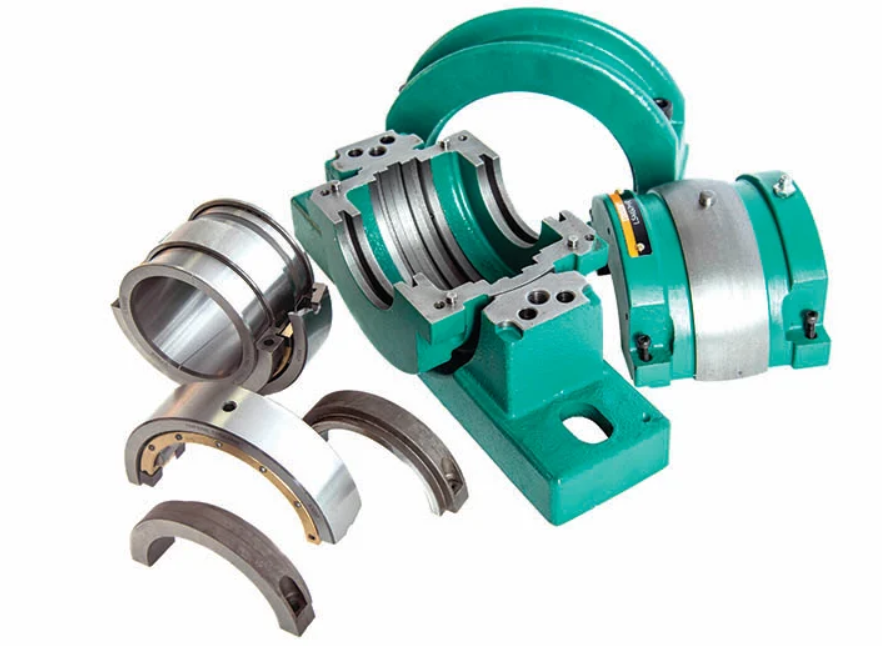 1. Structural Comparison
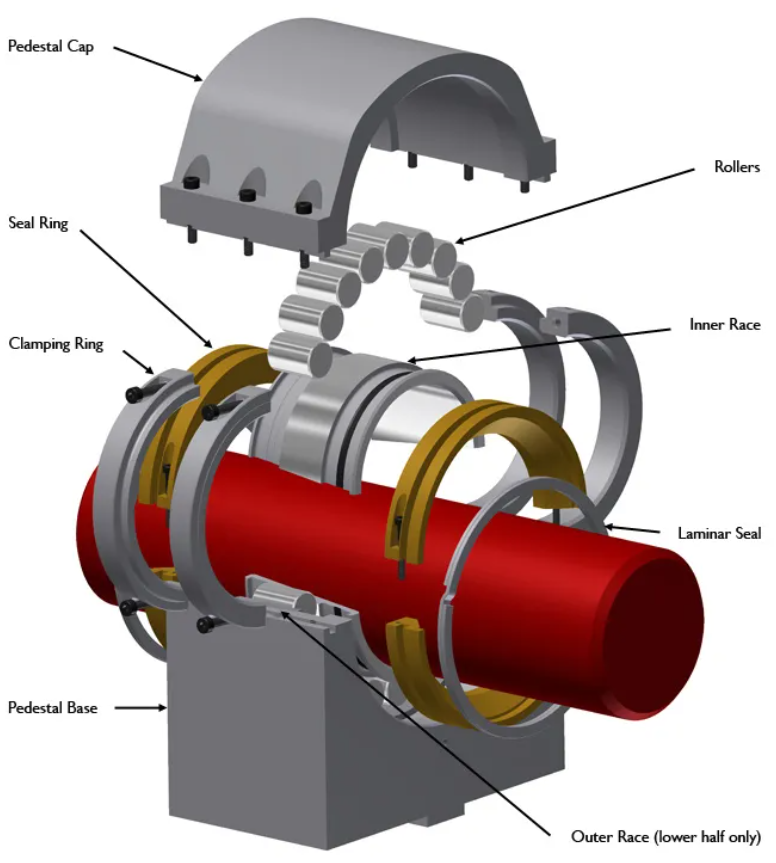
- Structure: Fully split horizontally into upper and lower halves, including housing, bearing inner/outer rings, rolling elements, cage and seals. Assembled and clamped with high-strength bolts.
- Materials: Mostly high-strength gray cast iron (GG25), ductile iron, or cast steel for heavy-duty applications.
- Self-alignment: Typically ±2°~±3° alignment capability to compensate for shaft misalignment.
- Sealing: Designed for harsh environments with felt, labyrinth, or multi-lip seals.
Standard Bearing Units
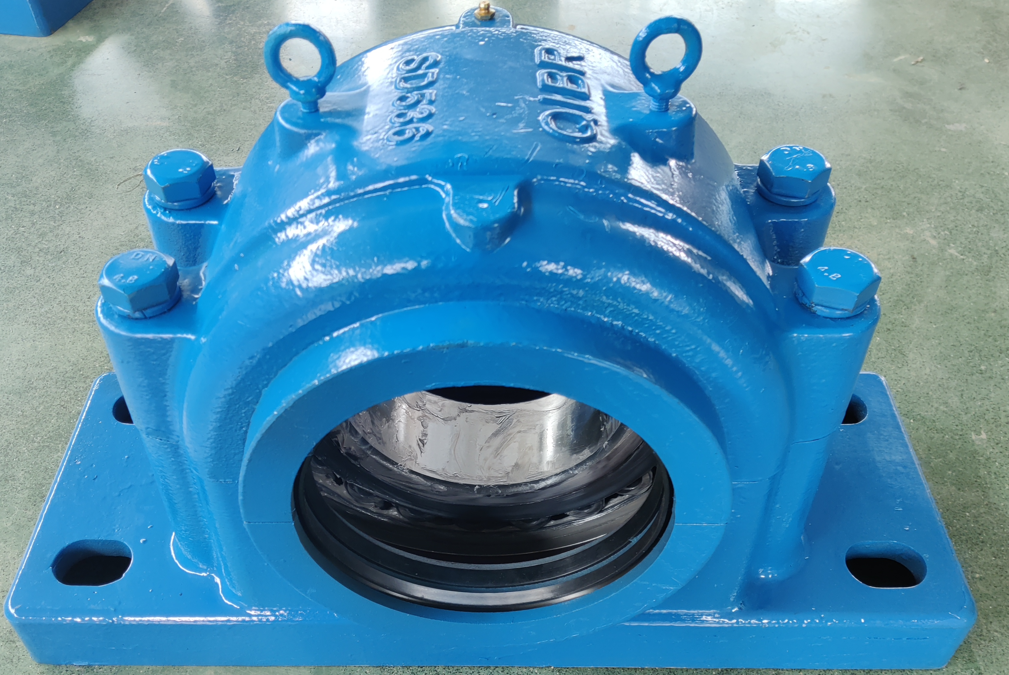
- Structure: Integrally cast or machined, non-split housing. Bearings must be installed axially from the shaft end.
- Materials: Cast iron, cast steel, or aluminum alloy for light-duty applications.
- Self-alignment: Alignment depends only on the insert bearing itself; housing has no alignment function.
- Sealing: Simple rubber lip seals for general working conditions.
2. Installation & Maintenance
- Installation: Mounted directly around the shaft without removing the shaft, couplings, gears or adjacent equipment.
- Maintenance: Extremely short downtime for bearing replacement; ideal for trapped shaft arrangements.
- Tools: No press or special mounting tools required; standard clearance is pre-set.
Standard Bearing Units
- Installation: Bearings must slide or be pressed onto the shaft from the open end, requiring accessible shaft ends.
- Maintenance: Shaft disassembly and removal of connected components are needed, leading to long downtime.
- Advantages: Simple structure, lower cost, good interchangeability and stable running accuracy.
3. Performance & Operating Conditions
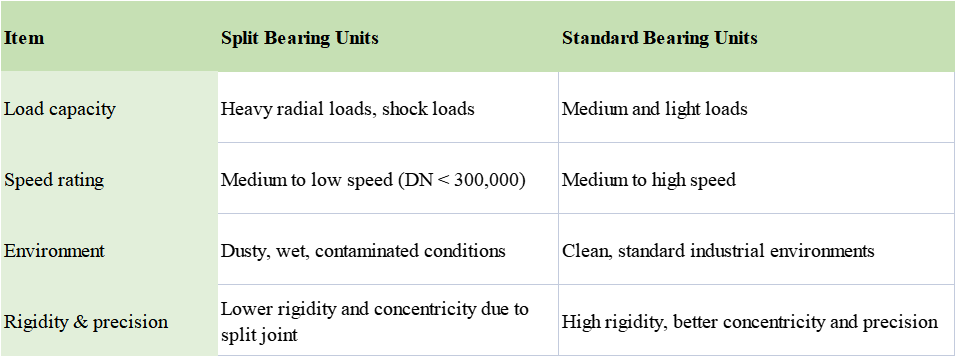
4. Typical Applications
- Metallurgy: Continuous casters, rolling mills, converter supports
- Mining: Crushers, mills, conveyors, elevators
- Power generation: Large fans, turbines, generators
- Pulp & paper, cement: Long shaft drives, roll supports
- Port & marine: Stackers, ship propulsion shafts, harbor machinery
- Trapped shaft applications where shaft removal is impossible
Standard Bearing Units
- General machinery: Small motors, pumps, fans, compressors
- Light industry: Textile, packaging, food processing, agricultural machinery
- High-speed & precision equipment: Machine tool spindles, precision drives
- Cost-sensitive mass-production applications
5. Selection Guidelines
Choose split bearing units if the shaft cannot be removed, downtime is costly, or under heavy-duty harsh conditions.
Choose standard bearing units for accessible shaft ends, high-speed requirements, precision applications, or budget-limited projects.