Newsroom
The 51148X Thrust Ball Bearing: A Cornerstone of Heavy-Duty Industrial Applications
In the intricate ecosystem of industrial machinery, bearings serve as the unsung heroes that enable smooth rotation and load transmission. Among these critical components, the 51148X thrust ball bearing stands out for its robust performance in heavy-duty applications, combining high load-bearing capacity with reliable operation. As a member of the thrust ball bearing family, this model is specifically engineered to handle axial loads—forces parallel to the shaft—making it indispensable in sectors ranging from construction to manufacturing. This article delves into the technical specifications, structural design, operational principles, applications, and maintenance practices of the 51148X bearing, highlighting its significance in modern industrial systems.
At the core of the 51148X bearing’s functionality lies its precise technical specifications, which define its compatibility and performance limits. According to data from leading manufacturers such as NSK and SKF, this bearing features a standardized set of dimensions that adhere to international standards like ISO 104 and ISO 199. Its inner diameter (d) measures 240 millimeters, outer diameter (D) 300 millimeters, and thickness (T) 45 millimeters—a compact profile that belies its load-handling capabilities. The bearing’s weight varies slightly by manufacturer, with NSK’s version weighing 6.55 kilograms and Regal Rexnord’s equivalent (51148 M) tipping the scales at 16.09 pounds (approximately 7.3 kilograms). These dimensional parameters are non-negotiable for proper installation, as mismatches can lead to premature wear or catastrophic failure.
Load capacity and rotational speed are the 51148X’s defining performance attributes. The bearing boasts an impressive dynamic load rating (Cr) of around 229–234 kN, which refers to the maximum constant axial load it can sustain while rotating at a given speed without fatigue failure. Its static load rating (C0r)—the maximum load it can bear while stationary—reaches 935–1040 kN, a testament to its ability to handle extreme pressure during startup or shutdown cycles. When it comes to rotational speed, the 51148Xoperates optimally at 850 rpm under grease lubrication and 1200 rpm with oil lubrication, with some variants offering slightly higher reference speeds of up to 1100 rpm. These figures are not arbitrary; they are carefully calibrated based on the bearing’s material composition and structural design.
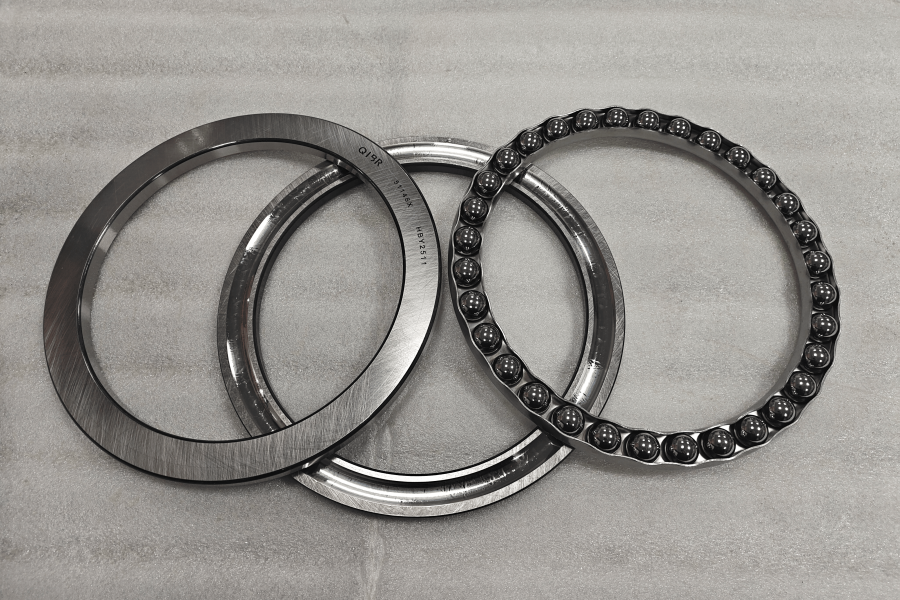
The 51148X’s reliability stems from its thoughtful structural design and high-quality materials. Like all thrust ball bearings, it comprises three key components: a shaft washer (inner ring) that attaches to the rotating shaft, a housing washer (outer ring) fixed to the machinery frame, and a cage assembly containing precision steel balls. The cage—typically made of brass—plays a crucial role in separating the steel balls, preventing friction between them, and guiding their movement along the raceways (grooves in the washers). This design converts sliding friction into rolling friction, minimizing energy loss and wear. The bearing’s core material is 52100 bearing steel, a high-carbon chromium alloy renowned for its exceptional hardness, wear resistance, and fatigue strength after through-hardening treatment. Some versions feature a flat seat design, while others offer self-aligning spherical seats to compensate for minor installation errors, enhancing operational stability.

The working principle of the 51148X is elegant in its simplicity yet highly effective. When axial load is applied to the rotating shaft, the force is transmitted to the shaft washer, which in turn pushes the steel balls against the stationary housing washer. As the shaft rotates, the steel balls roll smoothly along the raceways, transferring the load from the rotating component to the fixed structure without excessive friction. Importantly, the 51148X is a single-direction thrust bearing, meaning it only accommodates axial loads from one direction; it cannot handle radial loads (forces perpendicular to the shaft) and may fail if subjected to them. This directional specificity makes proper application selection critical.
The 51148X’s versatility is evident in its wide range of industrial applications. It is a staple in heavy machinery, including construction equipment like concrete mixers and excavators, where it supports the axial loads generated by rotating components during digging or mixing operations. In the machine tool industry, it is used in lathes and planers to stabilize spindle shafts, ensuring precision during cutting or shaping processes. The automotive sector relies on it for transmission systems, while the metallurgical and mining industries employ it in crushers and conveyor belts to handle the extreme loads of raw material processing. Its presence also extends to compressors, rubber extruders, and power generation equipment, where reliability under harsh conditions is paramount.

To maximize the 51148X’s service life, proper maintenance is essential. Installation is the first critical step: the shaft and housing must be thoroughly cleaned to remove debris, as even tiny particles can cause scratches on the raceways or steel balls. The bearing should be pressed into place using a hydraulic press, avoiding direct hammer blows that can damage the components. Lubrication is equally vital—grease or oil must be selected based on operating speed and temperature, with grease filling 1/3 to 1/2 of the bearing’s internal space to prevent overheating. Regular monitoring is necessary: operators should check for abnormal temperatures (using infrared thermometers), vibrations, or noise, which are early warning signs of wear or lubrication failure. When maintenance is required, the open-type design of the 51148X simplifies inspection and lubrication, reducing downtime.
In conclusion, the 51148X thrust ball bearing is a high-performance component that bridges the gap between heavy load requirements and operational efficiency. Its standardized dimensions, exceptional load capacity, and durable construction make it a trusted choice across diverse industries. By understanding its technical specifications, structural design, and maintenance needs, engineers and maintenance professionals can ensure that the 51148X operates at peak performance, minimizing downtime and maximizing the lifespan of the machinery it powers. As industrial systems continue to evolve, the 51148X remains a cornerstone of reliable, heavy-duty mechanical operation.