Newsroom
The KA050CP0 Thin-Section Bearing: Precision and Compactness for Modern Industry
In the era of miniaturized and high-precision machinery, thin-section bearings have emerged as indispensable components, bridging the gap between space constraints and performance demands. Among these specialized components, the KA050CP0 stands out as a benchmark for reliability and versatility in ultra-thin bearing applications. Designed to deliver exceptional precision while occupying minimal space, this radial contact thin-section ball bearing has become a cornerstone in industries ranging from semiconductor manufacturing to aerospace engineering. This article explores the structural characteristics, key specifications, application scenarios, and unique advantages that make the KA050CP0 an essential choice for modern industrial systems.
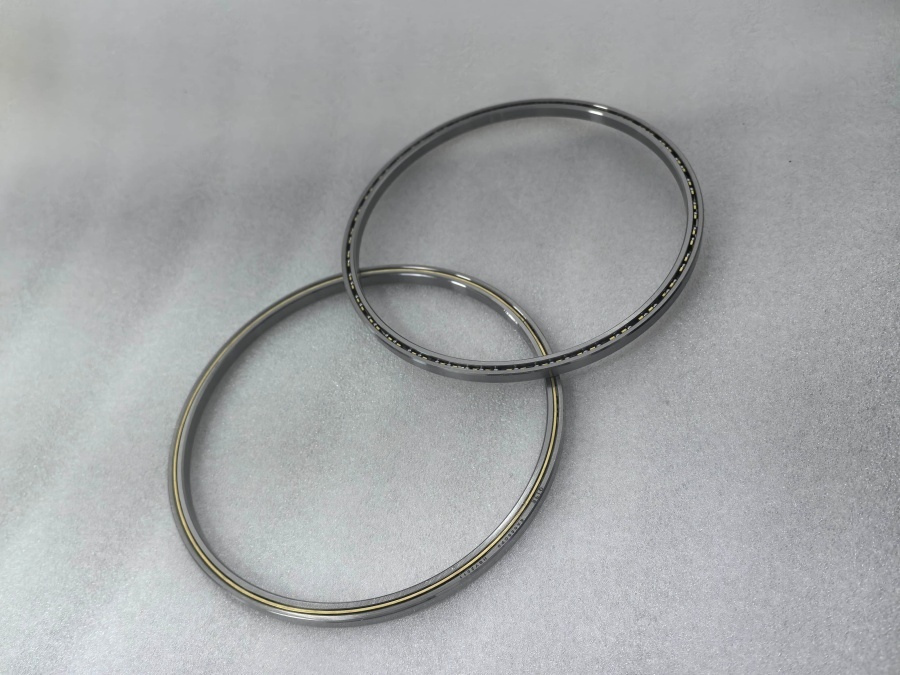
At the core of the KA050CP0’s functionality lies its innovative thin-section design, a defining feature that differentiates it from conventional bearings. Unlike standard bearings, where cross-sectional dimensions increase with inner diameter, the KA050CP0 belongs to the equal-section category—its cross-sectional width remains a constant 0.25 inches (6.35 mm) regardless of bore size, a trait that revolutionizes compact mechanical design. This fixed cross-section allows engineers to incorporate larger hollow shafts within their assemblies, facilitating the integration of cables, fluid lines, or optical components through the bearing’s center, thereby simplifying system architecture and reducing overall weight.
The KA050CP0’s dimensional specifications are tailored to balance compactness with load-bearing capability. It features a 5-inch (127.00 mm) inner diameter, a 5.5-inch (139.70 mm) outer diameter, and a weight of just 0.24 pounds (0.11 kg)—parameters that make it ideal for weight-sensitive applications. Beyond its physical dimensions, the bearing boasts impressive performance metrics: a maximum operating speed of 3810 rpm, a radial dynamic load capacity of 770 lbf (3425 N), and a radial static load capacity of 1590 lbf (7072 N). These figures demonstrate that despite its slim profile, the KA050CP0 can withstand significant mechanical stresses, making it suitable for both radial and moderate axial load applications. Its operating temperature range of -60°F to 250°F (-51°C to 121°C) further extends its usability across diverse environmental conditions, from industrial freezers to heated manufacturing environments.
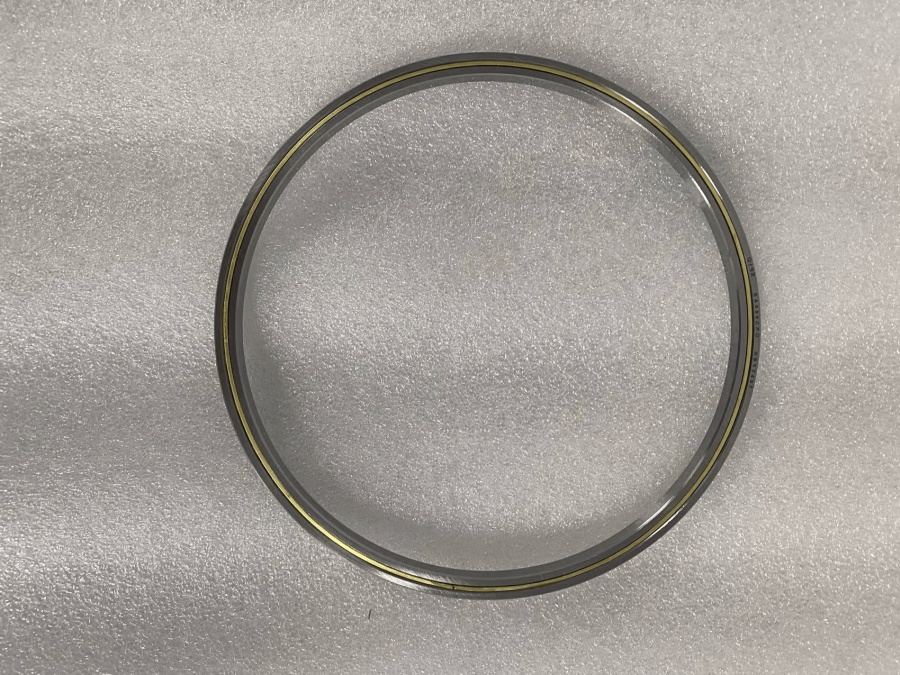
Material selection plays a pivotal role in the KA050CP0’s durability and precision. The bearing’s raceways and rolling elements are typically crafted from 52100 bearing-quality chrome steel, a material renowned for its high hardness, wear resistance, and fatigue strength. For applications requiring corrosion resistance—such as medical equipment or marine systems—stainless steel variants (often 440C) are also available, ensuring longevity in harsh or sterile environments. The bearing utilizes a brass or non-metallic cage, which serves to maintain uniform spacing between rolling elements, reduce friction, and prevent metal-to-metal contact during operation. This combination of materials is complemented by ultra-finished raceways, a manufacturing process that creates smooth surfaces to minimize vibration and enhance rotational accuracy—a critical feature for precision instruments.
The versatility of the KA050CP0 is reflected in its wide range of industrial applications, where its compactness and precision address unique engineering challenges. In semiconductor manufacturing, the bearing is used in wafer handling robots and lithography equipment, where its low vibration and high rotational accuracy ensure the delicate handling of silicon wafers during etching and deposition processes. Industrial robotics represents another key application area: the KA050CP0 is frequently integrated into robotic joints (waists, elbows, wrists) to support the complex, repetitive movements of assembly and welding robots while reducing overall robot weight and improving energy efficiency.

The medical and aerospace industries also benefit significantly from the KA050CP0’s design. In medical equipment such as diagnostic scanners and surgical robots, the bearing’s compact size allows for the miniaturization of devices, while its corrosion-resistant materials meet strict hygiene standards. In aerospace applications, from satellite communication devices to aircraft instrumentation, the bearing’s lightweight construction contributes to fuel efficiency, while its ability to withstand extreme temperatures ensures reliable performance in the harsh conditions of flight and space exploration. Even in optical and scanning equipment, the KA050CP0’s precision enables the smooth, accurate movement of lenses and sensors, critical for achieving high-resolution imaging.
What truly distinguishes the KA050CP0 from alternative bearings is its ability to deliver performance without compromising on space efficiency. Traditional bearings often require larger housings and more installation space, limiting design flexibility in compact systems. The KA050CP0’s equal-section design eliminates this constraint, allowing engineers to standardize related components and reduce overall system size and cost. Additionally, its compliance with rigorous industry standards—including MIL-PRF-23827 and MIL-PRF-3150—ensures consistent quality and reliability, making it a trusted choice for mission-critical applications.
As manufacturing technologies continue to advance toward greater automation and miniaturization, the demand for components like the KA050CP0 is set to grow. Its unique combination of compact design, high precision, and robust performance positions it as a key enabler of next-generation machinery. Whether in a semiconductor cleanroom, a robotic assembly line, or a medical operating room, the KA050CP0 demonstrates that thin-section bearings are not merely space-saving alternatives but essential components that drive efficiency, accuracy, and reliability in modern industrial systems. For engineers and designers seeking to balance performance with space constraints, the KA050CP0 remains a benchmark in thin-section bearing technology.