Newsroom
How to make a deep groove ball bearing withstand 30,000 r/min?
With the rapid development of hybrid and electric vehicles, environmental requirements necessitate smaller and lighter electric motors. Smaller motors result in lower output power, but to ensure the same or higher output power as current engines, higher-speed motors are needed. The following analysis and optimization of deep groove ball bearings for electric motors to withstand speeds exceeding 30,000 r/min (1.5 times the current deep groove ball bearing's limit speed) are discussed. 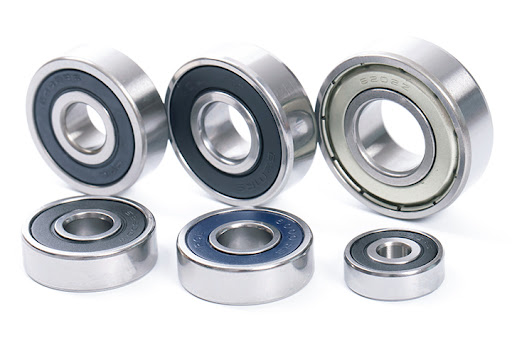
Influencing Factors Analysis
1) Lubrication
Oil lubrication is selected. Due to the high-speed rotation of the rolling elements and cage, a large amount of lubricating oil moves towards the outer diameter of the deep groove ball bearing under centrifugal force, resulting in insufficient lubrication between the inner ring and rolling elements, or between the rolling elements and cage. Insufficient lubrication can cause internal parts to stick, leading to deep groove ball bearing seizure. Increasing the amount of lubricating oil would increase the resistance generated by oil churning, thus increasing torque. 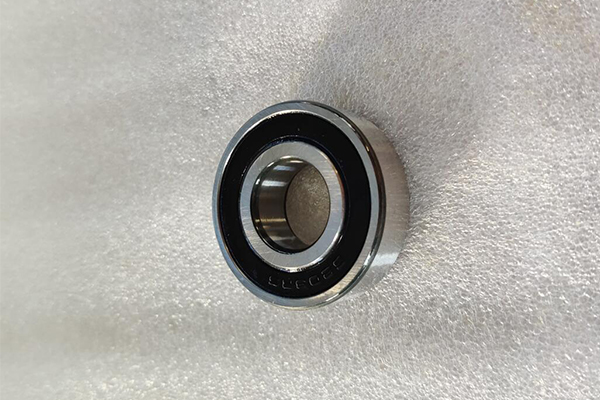
2) Friction
Friction between the balls and the raceway surface
When a deep groove ball bearing rotates, the sliding friction between the balls and the raceway surface is directly proportional to the bearing's rotational speed. At normal speeds, the effect of sliding friction is negligible. However, controlling the friction between the balls and the raceway surface is crucial under ultra-high speed conditions, as a sharp increase in friction leads to increased bearing heat generation. 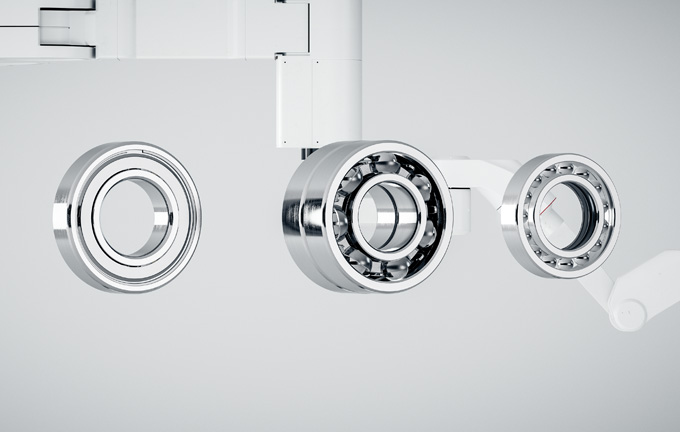
3) Cage Strength
A plastic crown cage is selected. During high-speed rotation, the outer surface of the plastic crown cage deforms under centrifugal force, causing the cage to contact the bearing's outer ring. When the cage contacts the outer ring, the deep groove ball bearing temperature rises. Furthermore, a pocket cage that has undergone significant deformation may fracture due to excessive stress on the pocket circumference. A reinforced cage structure needs to be developed to withstand the deformation and damage caused by centrifugal force. Cage strength can be increased by increasing the cage wall thickness, but this cannot increase the bearing width. 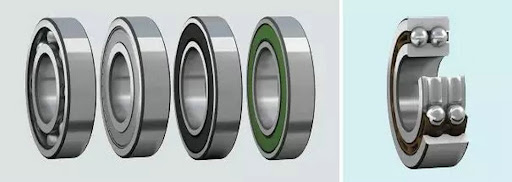
Optimization and Improvement
1) Install a baffle to control oil flow
2) Reduce friction
3) Improve cage strength 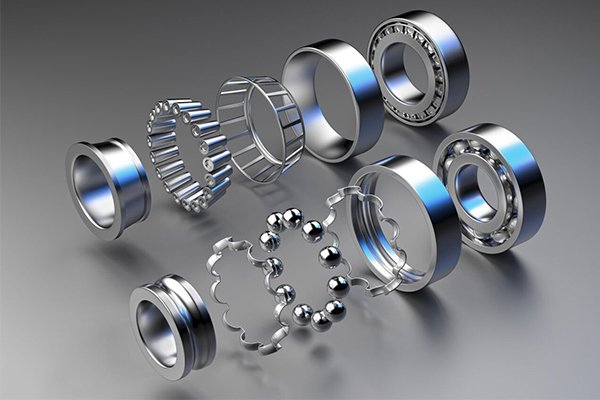
The optimized deep groove ball bearing design, through temperature rise testing and high-speed durability testing, can meet the ultra-high-speed operation requirements of 30,000 r/min.