Newsroom
KD065XP4 Precision Four-Point Contact Thin Section Bearing
In modern precision machinery manufacturing, thin-section bearings have become core foundational components for lightweight, miniaturized and high-precision equipment design. Among numerous professional bearing models, the KD065XP4 four-point contact thin-section ball bearing stands out for its compact structure, high rotation accuracy and excellent composite load capacity. It is widely adopted in high-end industrial automation, precision optics, medical equipment and aerospace light-duty mechanical structures, and has become a reliable choice for engineers pursuing balanced performance and space optimization.
The KD065XP4 belongs to the classic KD series thin-section bearing. Each letter and number in its model code carries clear engineering implications. The KD represents the fixed thin-section bearing series with constant cross-section design. The number 065 marks the standard inner diameter specification of the bearing, matching the unified size standard of the industry’s thin-section products. The letter X refers to the classic four-point contact raceway structure, while P4 indicates that the bearing is manufactured in strict accordance with P4 high-precision tolerance standards, which is far higher than the precision level of ordinary standard bearings. This clear coding design helps mechanical designers quickly confirm product attributes and complete accurate model selection in project development.
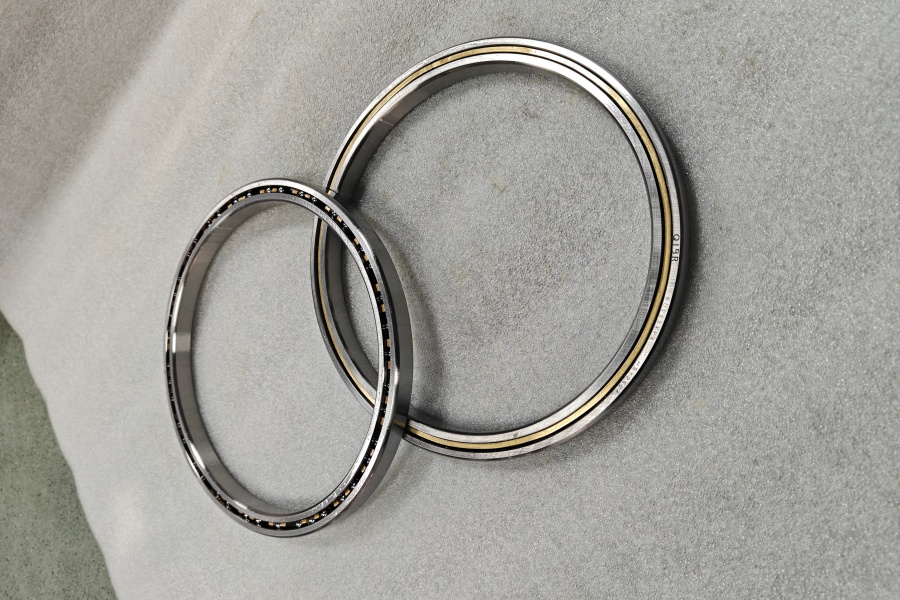
The most core design feature of KD065XP4 is its four-point contact gothic arch raceway structure. Different from traditional single-row radial bearings and ordinary angular contact bearings that can only bear single-direction load, this structural design enables the steel balls to form four stable contact points with the inner ring and outer ring raceways. With this advantage, a single KD065XP4 bearing can stably bear radial load, two-way axial load and overturning moment load at the same time. In many rotating structural designs, one KD065XP4 can replace two sets of paired angular contact bearings, which greatly simplifies the overall mechanical structure, reduces the number of parts, lowers assembly difficulty, and effectively controls the overall weight and occupied space of equipment.
As a thin-section bearing, the constant cross-section design is another major advantage of KD065XP4. Its wall thickness and cross-section size remain stable under standardized diameter specifications. This feature breaks the limitation of conventional bearings whose thickness increases with the inner diameter. It allows designers to appropriately increase the shaft diameter to improve structural rigidity without expanding the installation space of the bearing. This is particularly critical for limited installation scenarios such as robotic joint rotating parts and precision instrument rotating platforms, perfectly adapting to the development trend of modern equipment toward miniaturization and integration.
Classified as P4 high precision, KD065XP4 features extremely strict dimensional control and surface processing standards. In the production process, the inner and outer rings are processed by ultra-fine grinding, and the raceway surface achieves ultra-high smoothness. The high-precision steel balls are strictly screened in size and roundness, and matched with a high-stability cage. The overall product has extremely small radial runout and axial runout, with low operation vibration and stable rotation. Whether it is high-speed continuous operation or low-speed precise positioning, it can maintain excellent motion accuracy, which is irreplaceable for precision processing and detection equipment that require micron-level control.
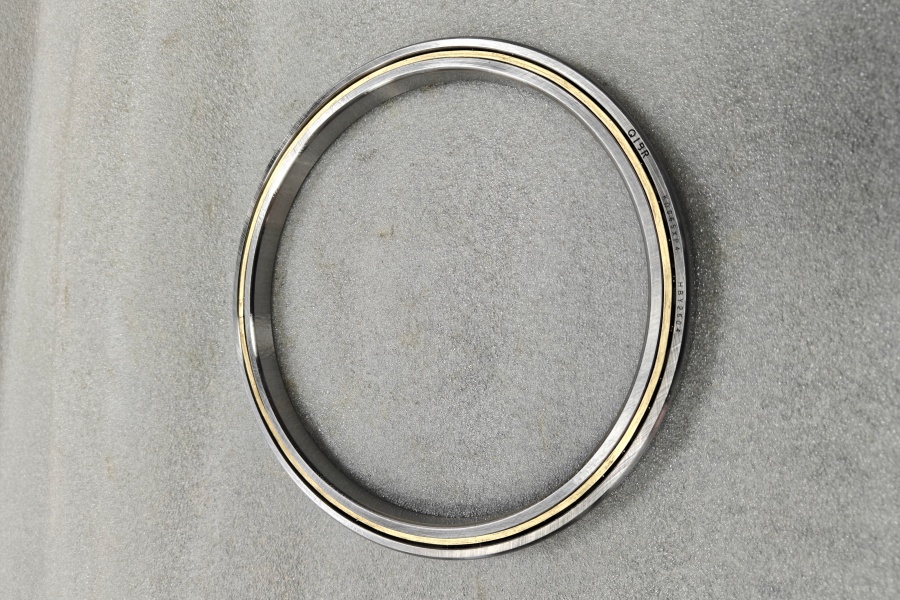
In terms of material and durability, KD065XP4 is made of high-quality bearing special alloy steel. After overall quenching and tempering heat treatment, the ring and steel ball have high surface hardness, strong wear resistance and contact fatigue resistance. The conventional cage is made of brass or high-performance engineering composite materials, which can reduce friction collision during operation, suppress running noise, and improve the smoothness of high-speed operation. Meanwhile, the bearing has good environmental adaptability, stable performance within a conventional temperature range, and good oxidation and rust resistance under normal working conditions.
In actual industrial applications, KD065XP4 shows strong versatility. It is commonly used in industrial robot rotating joints, automated production line rotary tables, and intelligent logistics handling equipment. In the high-precision industry, it serves optical detection instruments, semiconductor testing equipment and precision laser processing machinery. In the medical industry, it is applied to the rotating structure of medical imaging equipment and intelligent rehabilitation devices. In addition, it is also widely used in lightweight aerospace auxiliary mechanisms and high-end automated packaging equipment, providing stable rotating support for different scenarios.
Reasonable use and daily maintenance are essential to give full play to the performance of KD065XP4. During installation, violent knocking is forbidden to avoid damage to the precision raceway surface. According to structural rigidity requirements, appropriate preload can be applied to eliminate internal clearance and further improve operation stability. Daily lubrication should select high-temperature and high-precision special grease, and regularly replenish lubricants to reduce friction loss. For working environments with dust, moisture and corrosion, customized sealing structures can be selected to isolate pollutants and extend the service life of the bearing.
To sum up, the KD065XP4 four-point contact thin-section bearing integrates compact structural design, P4 high precision, composite load capacity and long service life. It solves many design pain points of limited installation space and high precision requirements in modern machinery. With reliable comprehensive performance and wide application adaptability, it continues to provide solid basic support for the upgrading and intelligent development of high-end manufacturing industry, and remains an indispensable key precision component in the field of thin-wall rotating transmission.