Newsroom
What are the characteristics and industry applications of precision crossed roller bearings?
Precision crossed roller bearings are structurally divided into inner or outer rings. After the rollers and cage are installed, they are firmly attached to the crossed roller rings, preventing separation. Furthermore, the installation of the crossed roller rings is very simple. Precision crossed roller bearings have some unique application characteristics.
The rollers of precision crossed roller bearings are arranged in a cross pattern, so only one set of crossed roller rings is needed to withstand loads in all directions, increasing rigidity by 3-4 times compared to conventional models. 
Because the inner or outer ring of a precision crossed roller bearing has a two-part structure, the bearing clearance is adjustable, allowing for high-precision rotational movement even under preload.
Precision crossed roller bearings can simultaneously withstand loads from various directions (such as axial, thrust, or momentum loads). Because the rollers are in direct contact with the raceway surface, the probability of elastic deformation of the bearing under load is very small. 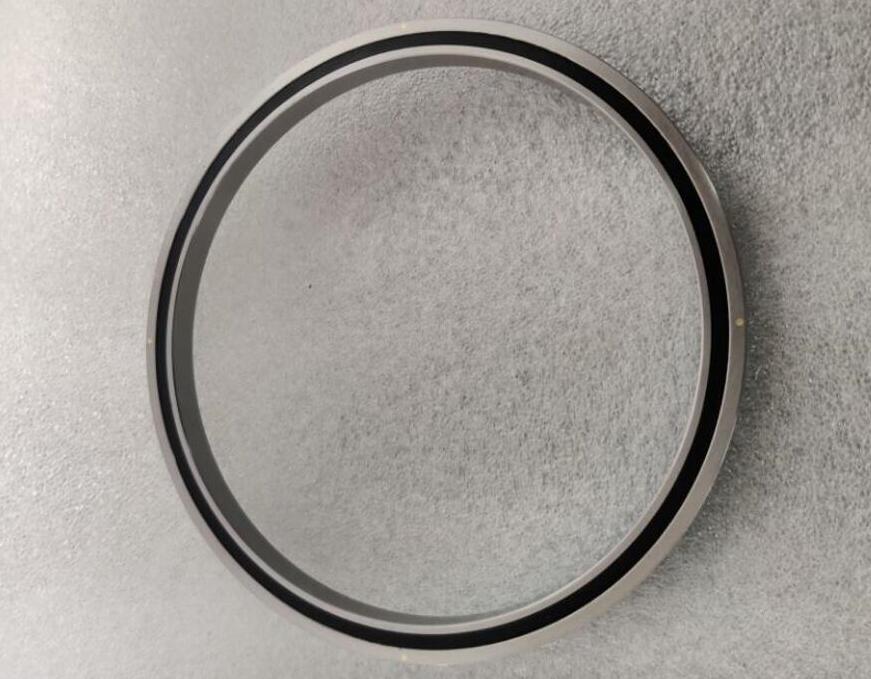
In precision crossed roller bearings, the cylindrical rollers are arranged perpendicularly to each other on a 90° V-groove rolling surface via a cage. Therefore, a single precision crossed roller bearing can withstand loads in all directions, including radial, axial, and moment loads.
The dimensions of the inner and outer rings are minimized to a great extent, with ultra-thin models approaching the limits of miniaturization, while maintaining high rigidity. 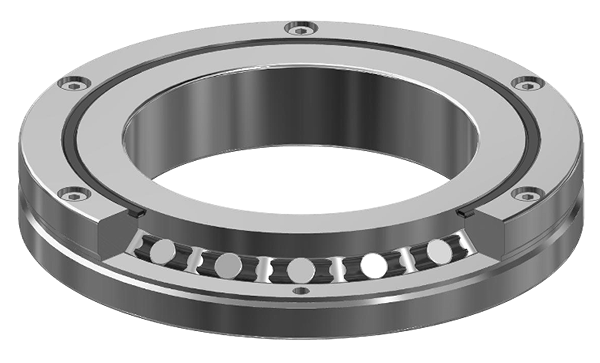
Precision crossed roller bearings are widely used in applications such as industrial robots, rotary tables in machining centers, rotating parts of robotic arms, ultra-precision rotary tables, machine tools, and medical equipment.