Newsroom
CPM 2441 Double Row Angular Contact Ball Bearing: Structure, Performance and Applications
In the field of industrial transmission and mechanical equipment, bearings serve as core components that reduce friction, support loads, and ensure precise operation. Among various types of bearings, double row angular contact ball bearings stand out for their ability to withstand both radial and bidirectional axial loads, making them indispensable in scenarios requiring high rigidity, stability, and rotational accuracy. The CPM 2441 double row angular contact ball bearing, developed by CPM Bearings Italy, is a high-performance product tailored for heavy-duty industrial applications, combining robust structural design, reliable performance, and broad adaptability. This article aims to comprehensively introduce the structure, technical specifications, manufacturing process, application fields, and maintenance methods of this bearing, providing a detailed reference for professionals in related industries.
1. Model Interpretation and Structural Characteristics
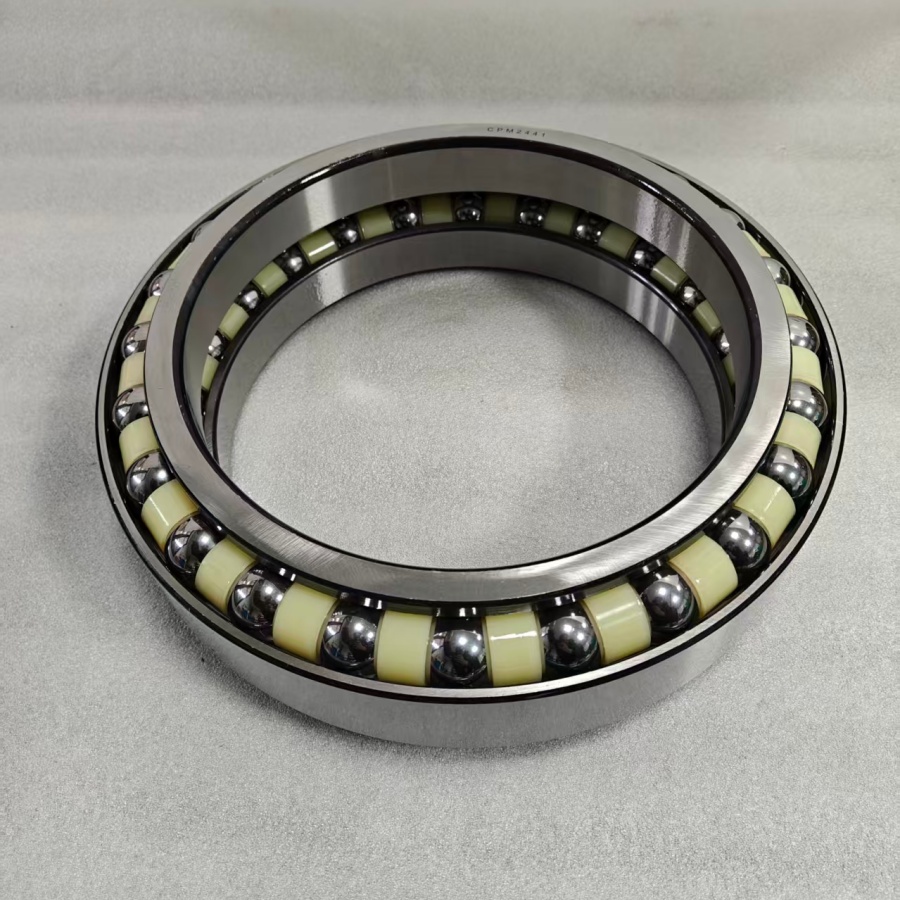
The model CPM 2441 contains key information about the bearing’s specifications and design, which is crucial for understanding its performance and application scope. The prefix “CPM” indicates the brand—CPM Bearings Italy, a manufacturer known for producing high-quality industrial bearings. “2441” is the core model number, identifying the specific series and structural design of the bearing. The suffix “H06” represents the precision grade and structural modification, ensuring the bearing meets standard precision requirements for industrial applications. “D312/D230” specifies the key dimensional parameters: the outer diameter (D) is 312 mm, and the inner diameter (d) is 230 mm, indicating that this is a medium-to-large-sized bearing suitable for heavy-load scenarios. Finally, “B85” denotes the bearing width (B) of 85 mm, which contributes to its high rigidity and load-bearing capacity by increasing the contact area between the bearing and the shaft/housing.
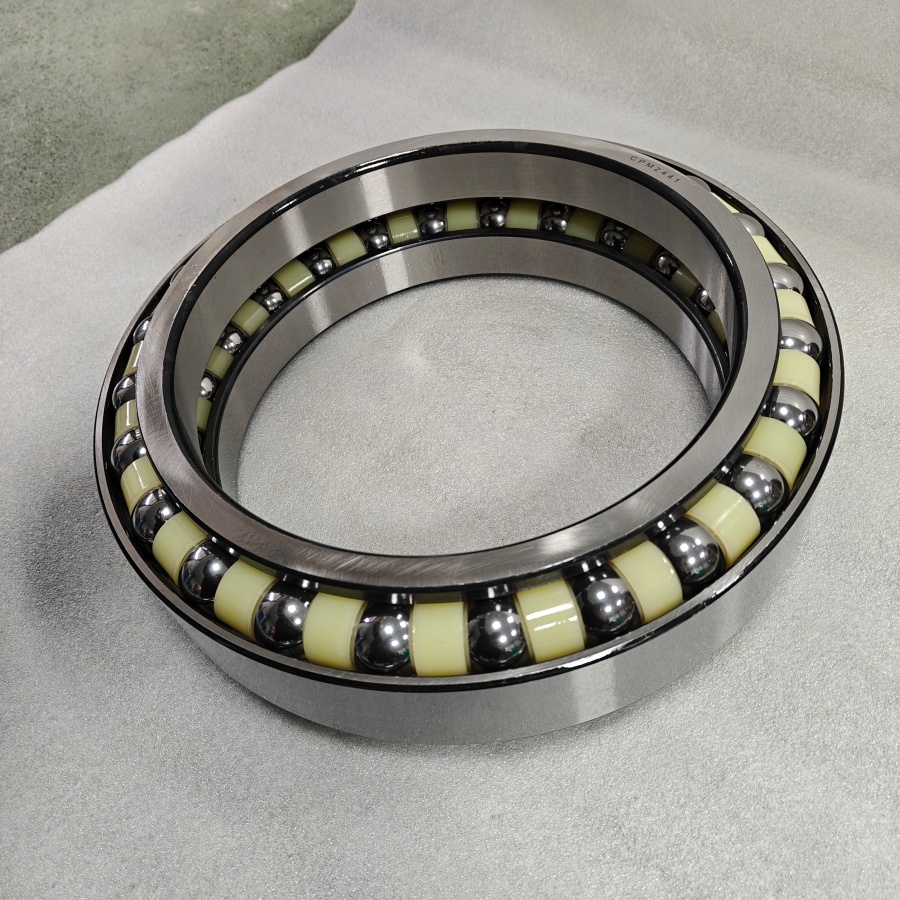
Structurally, the CPM 2441 adopts the classic double row angular contact design, which is equivalent to a pair of single row angular contact ball bearings arranged back-to-back but integrated into a single unit, requiring less axial space than two separate single row bearings. The bearing features a cylindrical bore, a common design that ensures easy installation and compatibility with standard shafts. It is an open-type bearing without seals, allowing for flexible lubrication choices and adaptation to various operating environments where seal installation is handled by the equipment itself. The cage is made of steel or a standard material, selected for its high strength, wear resistance, and ability to maintain stable operation under heavy loads and moderate speeds. The contact angle is set at 30 degrees, a common configuration for double row angular contact bearings that balances radial and axial load-bearing capabilities, making the bearing suitable for applications with combined radial and bidirectional axial loads.
2. Technical Specifications and Performance Advantages
The technical specifications of the CPM 2441 are tailored to meet the demands of heavy-duty industrial operations, with key parameters derived from product data and reasonable inferences based on similar bearing models (given the partial unavailability of complete official data):
- Dimensional Parameters: Inner diameter (d) = 230 mm, outer diameter (D) = 312 mm, width (B) = 85 mm, chamfer dimension (r) ≈ 2-3 mm (minimum), ensuring smooth installation and avoiding stress concentration at the shaft-housing interface.
- Contact Angle: 30 degrees, providing an optimal balance between radial load capacity (suitable for heavy radial forces) and axial load capacity (capable of withstanding large bidirectional axial forces and tilting moments).
- Radial Internal Clearance: CN (normal internal clearance), ensuring stable operation under standard temperature conditions and reducing friction during start-up and operation.
- Load Capacity: Based on similar-sized double row angular contact bearings, the basic dynamic load rating (C) is estimated to be 380-420 kN, and the basic static load rating (C0) is approximately 500-550 kN, enabling it to withstand heavy and continuous loads in industrial equipment.
- Speed Performance: The limiting speed (grease lubrication) is estimated to be 2200-2500 r/min, and the reference speed (oil lubrication) is around 2800-3000 r/min, suitable for medium-speed heavy-duty applications.
- Temperature Range: Up to 120°C without heat stabilization, adapting to most industrial operating environments, with a low-temperature limit of -40°C, ensuring reliable performance in cold working conditions.
- Precision Grade: Standard precision, meeting the requirements of general industrial equipment for rotational accuracy, with optional high-precision grades available for specialized applications such as precision machine tools.
The performance advantages of the CPM 2441 are closely linked to its structural design and technical specifications. Firstly, its double row structure provides higher rigidity and stability compared to single row bearings, reducing shaft deflection and ensuring precise rotational motion, which is critical for equipment requiring high operational accuracy. Secondly, the 30-degree contact angle and large width (85 mm) enhance its load-bearing capacity, making it suitable for heavy-duty equipment such as industrial gearboxes, cranes, and large motors. Thirdly, the open-type design and steel cage improve durability and heat dissipation, extending the bearing’s service life under continuous operation. Additionally, the standard dimensional design and cylindrical bore ensure strong interchangeability, facilitating maintenance and replacement in industrial settings.
3. Materials and Manufacturing Process
The performance and service life of the CPM 2441 are largely determined by its materials and manufacturing process, which follow strict industrial standards to ensure reliability and consistency.
Raw materials are carefully selected based on performance requirements. The inner and outer rings are made of high-carbon chromium steel (e.g., SAE 52100), a common material for industrial bearings due to its high hardness, wear resistance, and corrosion resistance after heat treatment. The rolling elements (balls) are made of the same steel as the rings, with higher hardness requirements to withstand repeated contact stress. The cage is made of steel, which offers superior strength and durability compared to non-metallic cages, making it suitable for heavy-load applications.
The manufacturing process involves multiple key stages, ensuring precision and quality at every step: 1) Raw Material Preparation: The steel bar stock is inspected for quality, cut to length, and surface imperfections are removed. 2) Forging: Hot forging is used to shape the inner and outer rings, improving the grain structure and enhancing material strength. 3) Turning: CNC lathes are used to rough-turn the forged rings to approximate dimensions, removing excess material. 4) Heat Treatment: Quenching and tempering are performed to harden the steel (forming martensite) and reduce brittleness, controlling the final hardness and toughness. 5) Precision Grinding: The rings and rolling elements are precision-ground to achieve the required dimensional accuracy and surface finish. 6) Assembly: The components are assembled, with strict control of internal clearance. 7) Inspection and Testing: Each bearing undergoes dimensional inspection, load testing, and rotational accuracy testing to ensure compliance with standards. 8) Lubrication and Packaging: Standard lubrication is applied, and the bearings are packaged to prevent contamination during transportation and storage.
4. Application Fields
Due to its heavy-load capacity, high rigidity, and stable performance, the CPM 2441 is widely used in various heavy-duty industrial fields, particularly in equipment requiring combined radial and axial load support:
- Industrial Gearboxes: Used in large gearboxes for metallurgy, mining, and construction machinery, where it withstands heavy radial and axial loads generated by gear meshing, ensuring smooth power transmission.
- Heavy Machinery: Applied in cranes, excavators, and bulldozers, supporting the rotating components (e.g., shafts, gears) and withstanding dynamic loads during operation.
- Large Motors and Generators: Used in the shafts of high-power motors and generators, where it supports the rotor and withstands the axial thrust generated by electromagnetic forces, ensuring stable rotational speed.
- Machine Tools: Suitable for heavy-duty lathes, milling machines, and grinders, providing high rigidity and rotational accuracy to ensure machining precision.
- Marine and Offshore Equipment: Used in marine gearboxes and propeller shafts, adapting to harsh environments (e.g., humidity, temperature variations) and withstanding heavy loads.
5. Maintenance and Service Life Extension
Proper maintenance is essential to extend the service life of the CPM 2441 and ensure its stable performance. Here are key maintenance recommendations:
- Lubrication: Regularly check and replace lubricants (grease or oil) to ensure adequate lubrication, reduce friction and wear, and prevent overheating. The lubricant type should be selected based on operating speed and temperature, with standard lubrication recommended for most applications.
- Installation: Ensure correct installation with proper coaxiality between the shaft and housing to avoid misalignment, which can cause uneven load distribution and premature wear. Use appropriate tools to press the bearing into place, avoiding direct impact on the rolling elements.
- Contamination Prevention: Keep the bearing and its installation environment clean to prevent dust, debris, and moisture from entering, which can damage the rolling elements and raceways. Use seals or shields if the operating environment is dusty or humid.
- Temperature Monitoring: Regularly monitor the operating temperature of the bearing; excessive temperature (exceeding 120°C) indicates potential issues such as insufficient lubrication or misalignment, which should be addressed promptly.
- Regular Inspection: Periodically inspect the bearing for wear, corrosion, or damage (e.g., scratches on raceways, worn rolling elements). Replace the bearing if any defects are found to avoid equipment failure.
6. Conclusion
The CPM 2441 double row angular contact ball bearing is a high-performance, heavy-duty bearing designed to meet the demanding requirements of modern industrial applications. Its rational structural design (double row, 30-degree contact angle, 85 mm width), precise dimensional control, and high-quality materials ensure excellent load-bearing capacity, rigidity, and stability. With an estimated inner diameter of 230 mm, outer diameter of 312 mm, and robust manufacturing process, this bearing is well-suited for industrial gearboxes, heavy machinery, large motors, and other equipment requiring reliable performance under heavy loads. By following proper maintenance practices, users can maximize the bearing’s service life, reduce equipment downtime, and improve operational efficiency. As industrial equipment continues to develop toward higher loads and precision, the CPM 2441 will remain a critical component supporting the stable operation of heavy-duty industrial systems.