Newsroom
Why Are Crossed Roller Bearings Widely Used in Rotary Tables??
2026-03-13Rotary tables play a critical role in automation systems and CNC machinery, where high-precision rotation and load capacity are essential. To meet these demanding requirements, Crossed Roller Bearing has become the preferred solution thanks to its compact structure, high rigidity, and multi-directional load capacity.
1. Key Bearing Requirements in Rotary Table Applications
In real-world operation, rotary tables are subjected to complex and combined loads, including:
- Axial loads
- Radial loads
- Overturning moments
At the same time, rotary tables are often used for indexing, positioning, or continuous rotation, which requires:
- High rotational accuracy
- Stable repeat positioning
- Excellent structural rigidity
- Amplified positioning errors
- Unstable motion
- Increased vibration
2. Structural and Performance Advantages of Crossed Roller Bearings
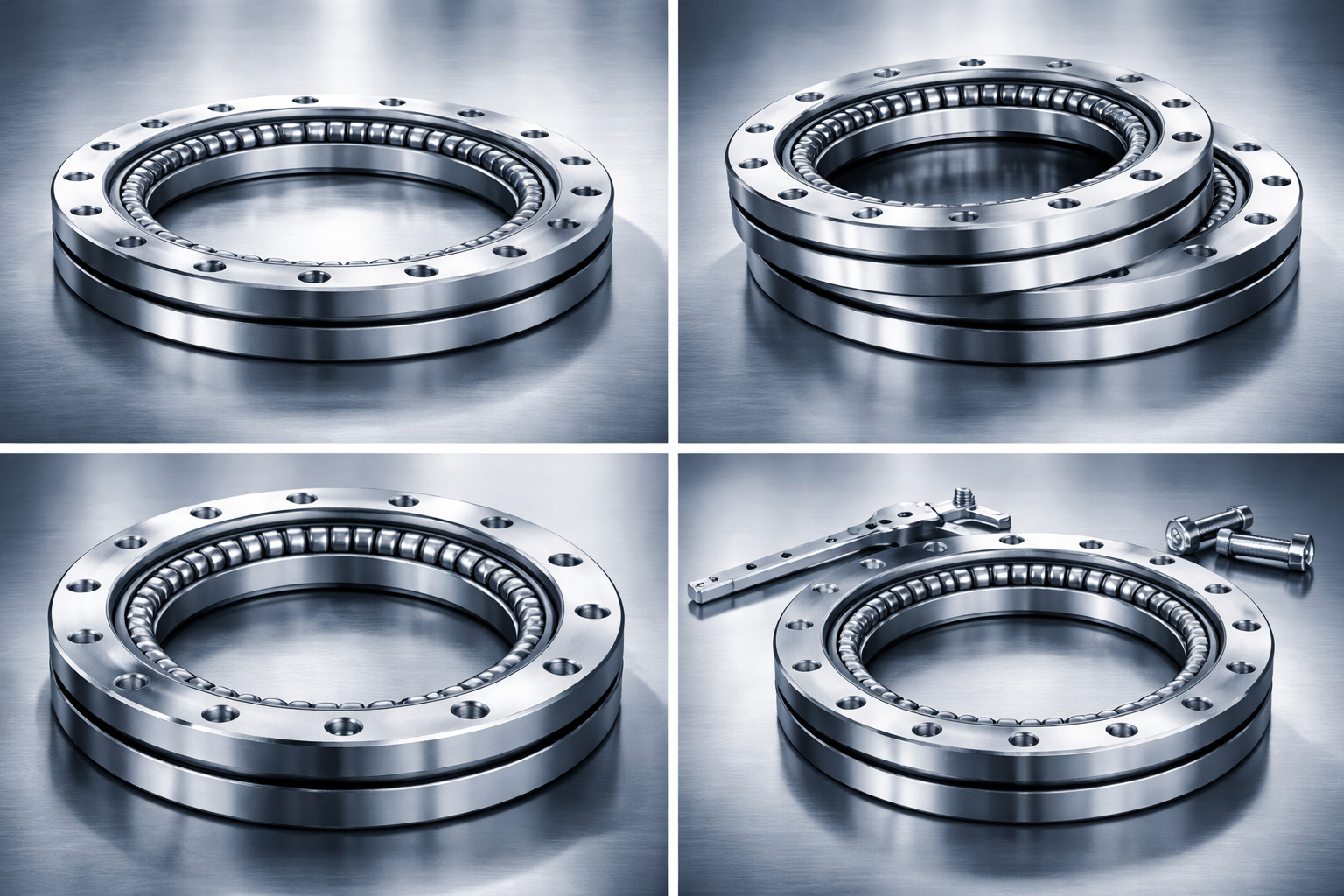
The design of a crossed roller bearing features cylindrical rollers arranged alternately at 90°, allowing a single bearing to support loads in all directions.
Key advantages include:
- Multi-directional load capacity:One bearing can simultaneously handle axial, radial, and moment loads
- High rigidity (line contact design):The line contact between rollers and raceways ensures minimal elastic deformation
- Integrated structure:Typically designed with one-piece inner and outer rings, reducing assembly errors
- Improved moment resistance:The crossed roller arrangement effectively resists overturning forces
These characteristics make crossed roller bearings ideal for compact, high-performance rotary table designs.
3. Benefits for Precision Retention and System Simplification
In rotary table design, a crossed roller bearing can often replace multiple sets of angular contact or thrust bearings, providing significant system-level advantages:
- Simplified structure:Fewer components and mounting surfaces
- Reduced assembly errors:Minimizes tolerance stack-up (coaxiality and perpendicularity errors)
- Stable preload capability:Ensures consistent rigidity in both axial and radial directions
- Long-term accuracy retention:Less performance degradation over time
These benefits are especially valuable in applications such as:
- CNC rotary tables
- Precision assembly platforms
- Inspection and measurement equipment
4. Key Advantages at a Glance
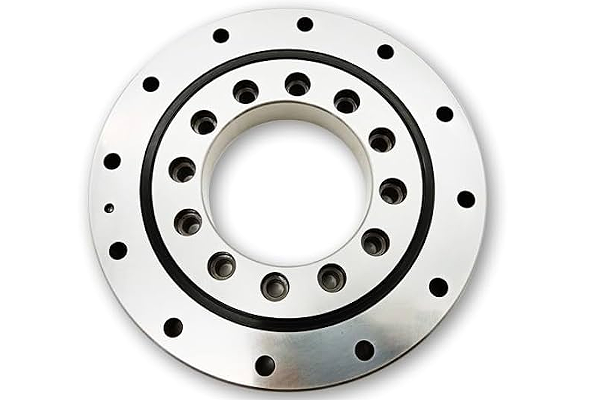
- Supports multi-directional loads with a single bearing
- Compact design, saving installation space
- High rigidity, ensuring rotational accuracy
- Reduced assembly complexity and error accumulation
5. Conclusion
The widespread use of acrossed roller bearing in rotary tables is no coincidence. Their unique structure perfectly matches the demanding working conditions of rotary systems. By combining high rigidity, multi-load capability, and structural integration, crossed roller bearings significantly enhance precision, stability, and reliability, making them the optimal choice for modern rotary table applications.